Strategy Overview: The Mathematics of Importing
Target Audience: High-volume buggy importers, B2B fleet buyers, and international dealership CFOs.
Core Challenge: Falling for artificially low "FOB" (Free On Board) prices from small suppliers, only to see profit margins wiped out by inefficient container loading, skyrocketing ocean freight, and severe transit damage.
Keldi Solution: Advanced 3D SKD (Semi-Knocked Down) steel-frame packaging and intelligent container spatial engineering that drastically reduces per-unit shipping costs and guarantees zero-damage arrival.
Result / ROI: Drops the actual "Landed Cost" to the absolute minimum, ensuring the profit margin you calculated on day one is the exact cash you collect at the end of the sale.
In the global B2B golf cart trade, buyers are obsessed with the initial quote. You contact a supplier, and they offer you an incredibly low FOB price. You run a quick spreadsheet, see massive potential margins, and immediately wire the deposit.
But experienced vehicle importers know a harsh truth: FOB pricing is an illusion. Your real business metric is the Landed Cost—the total price of the buggy once it has arrived at your warehouse, cleared customs, and is sitting on your showroom floor. Small assembly workshops use cheap FOB prices as bait, but they possess absolutely no logistics optimization capacity. By the time that "cheap" buggy crosses the ocean, hidden expenses will have completely devoured your expected profit.
When you buy from an inexperienced supplier, the financial bleeding happens inside the shipping container.
The Air-Shipping Penalty: Small suppliers pack fully assembled carts into standard wooden crates. Because they don't know how to optimize space, you end up paying thousands of dollars to ship "empty air" across the ocean. Your per-unit freight cost skyrockets.
The Damage Lottery: Cheap wooden crates shift and collapse during rough sea transit. When the container doors open, you are greeted with scratched paint, cracked windshields, and bent chassis.
The Customs Nightmare: Poorly documented, haphazardly packed containers frequently trigger customs holds, leading to massive port storage fees (demurrage) that drain your cash flow daily.
Suddenly, that "cheap" buggy is 25% more expensive than you budgeted.
At Keldi, we understand that our job doesn't end when the buggy leaves the assembly line; it ends when you achieve a profitable resale. To protect your true Landed Cost, our manufacturing scale is paired with military-grade logistics engineering.
1. Precision SKD (Semi-Knocked Down) Dismantling
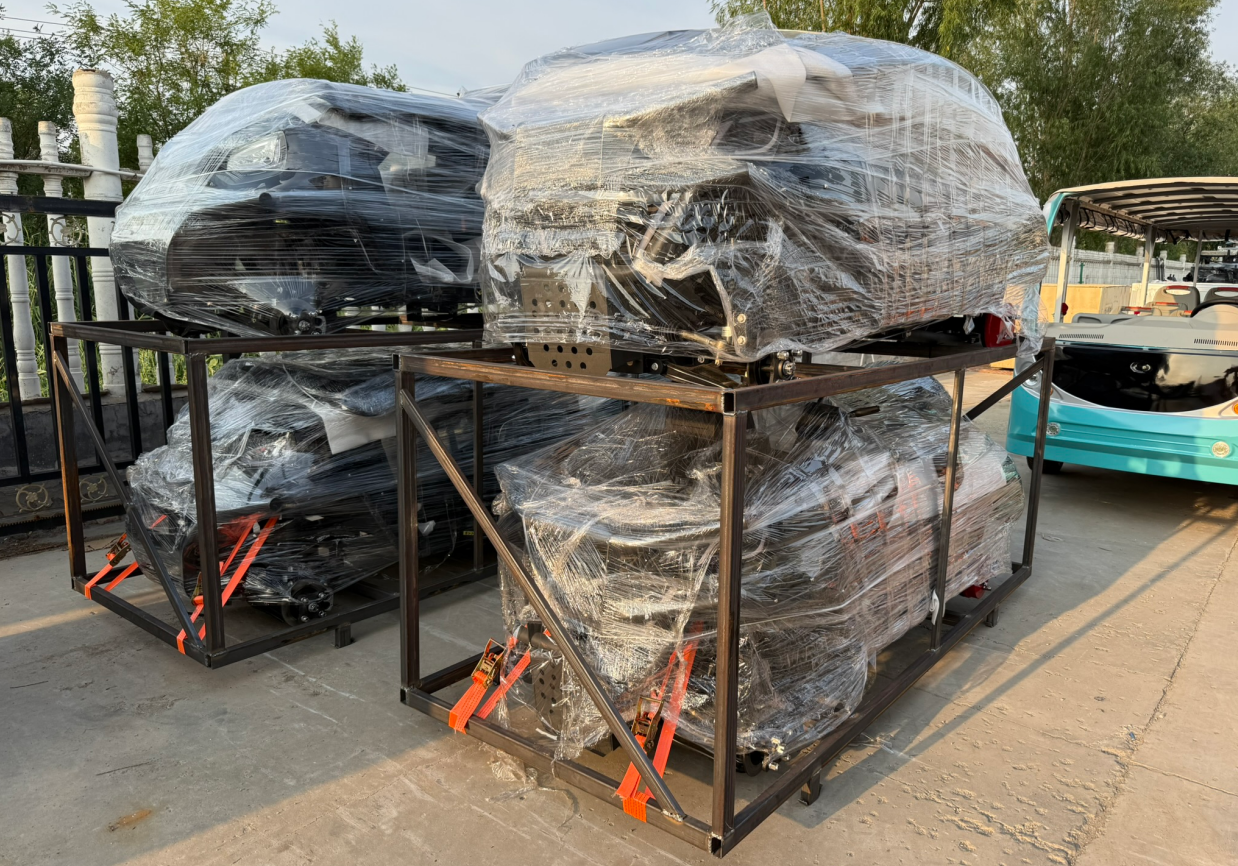
We do not ship empty space. Before loading, our professional packaging teams execute a precise SKD process, systematically removing high-profile components like roof canopies and windshields to drastically compress the vehicle’s vertical footprint.
2. Heavy-Duty 3D Steel Frame Armor
We abandoned flimsy wooden crates years ago. Every Keldi buggy is locked inside a custom-welded, heavy-duty rigid steel frame (as seen above). These frames are mathematically designed to match the exact dimensions of standard 40HQ shipping containers, absorbing all transit shock and preventing any physical weight from resting on the vehicle's suspension.
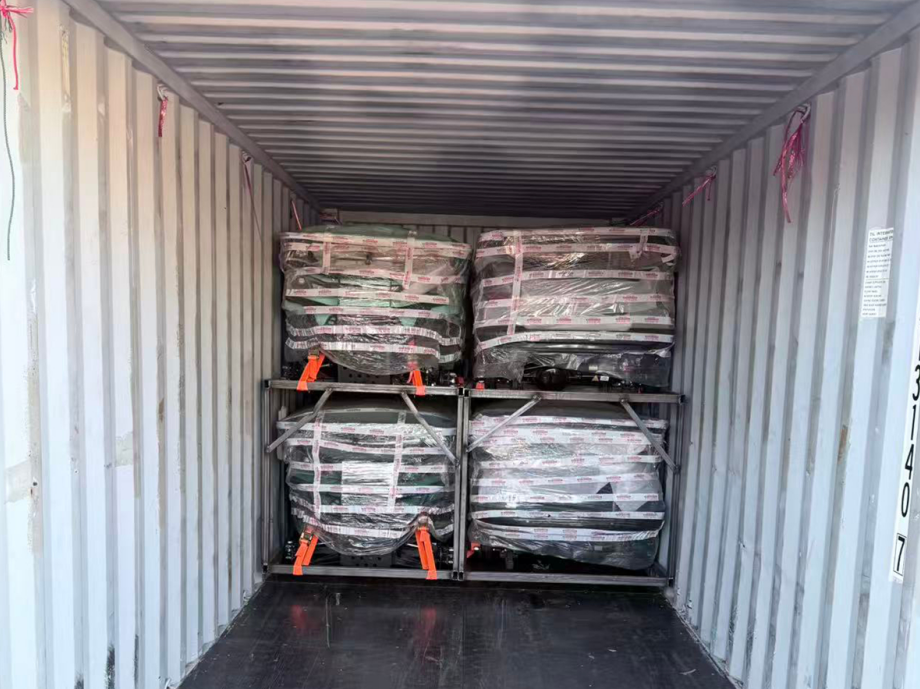
3. Maximized Container Density (The 24-Unit Secret)
Because of the rigid steel frames and precise CAD packing diagrams, we can safely execute multi-tiered 3D stacking inside the shipping container. Instead of shipping 8 or 10 assembled carts, our SKD method achieves staggering density. For example, a single 40HQ container can safely hold up to 24 units of our standard 2-seater (or 2+2) models, and up to 18 units of our 4-seater (or 4+2) models. This high-density loading drastically slashes your ocean freight cost per unit, dropping your Landed Cost and immediately widening your profit margin.
Q: What is the exact 40HQ container loading capacity for Keldi buggies? A: Thanks to our 3D steel-frame SKD packing, our loading efficiency is mathematically optimized. For a standard 40HQ container, we can securely load:
Up to 24 units (2-seat & 2+2 seat standard models)
Up to 18 units (4-seat & 4+2 seat standard models)
Up to 14 units (6-seat models)
Up to 10 units (8-seat shuttle models)
Q: What is the difference between FOB and Landed Cost in buggy importing?
A: FOB (Free On Board) is just the factory price. Landed Cost is the true final cost, including FOB, ocean freight, insurance, port fees, customs duties, and inland transport. Packing 24 units into one container instead of 10 completely transforms your Landed Cost calculations.
Q: Will SKD (Semi-Knocked Down) packaging make the buggies hard to assemble when they arrive?
A: Not at all. Keldi's SKD process only removes simple, non-mechanical top components (like roofs and supports). The core powertrain, chassis, and complex wiring remain fully intact and factory-tested, requiring only straightforward reattachment by your local team.
The smartest importers don't just negotiate the factory price; they optimize the entire supply chain. Stop letting inefficient suppliers burn your capital on wasted container space and transit damage.
Partner with a source manufacturer that engineers logistics just as rigorously as they engineer vehicles. Contact Keldi today to request our full Container Packing Diagram for your next fleet order, and let us show you exactly how much freight cost we can save you.
--------------------------------------------------
KELDI Golf Cart & Sightseeing Buggy | Source Manufacturer
—— Delivering High-Profit, Ultra-Stable Electric Transport Solutions Globally
Skip the middleman markups and unreliable builds. Backed by massive source-factory manufacturing, Keldi provides comprehensive fleet solutions—from heavy-duty anti-corrosion engineering and rapid delivery to lifetime spare parts supply—maximizing your ROI and ensuring seamless operations.
📧 Get Direct Factory Quotes: info@keldigolfcart.com
🌐 Explore Factory Capabilities: www.keldigolfcart.com
📞 WhatsApp / WeChat: +86 15068872777

Built to Mod, Born to Profit.
The ultimate platform for custom golf cart professionals.
Shandong Dezhou
+86 15068872777
info@keldigolfcart.com
Whatsapp:

© KELDI2026.All right reserved.Powered by KELDI
China HQ: Shandong, Dezhou
Whatsapp:+86 +86 15068872777